
In this guide
The first few hours
Pack for the gap between boarding and unpacking
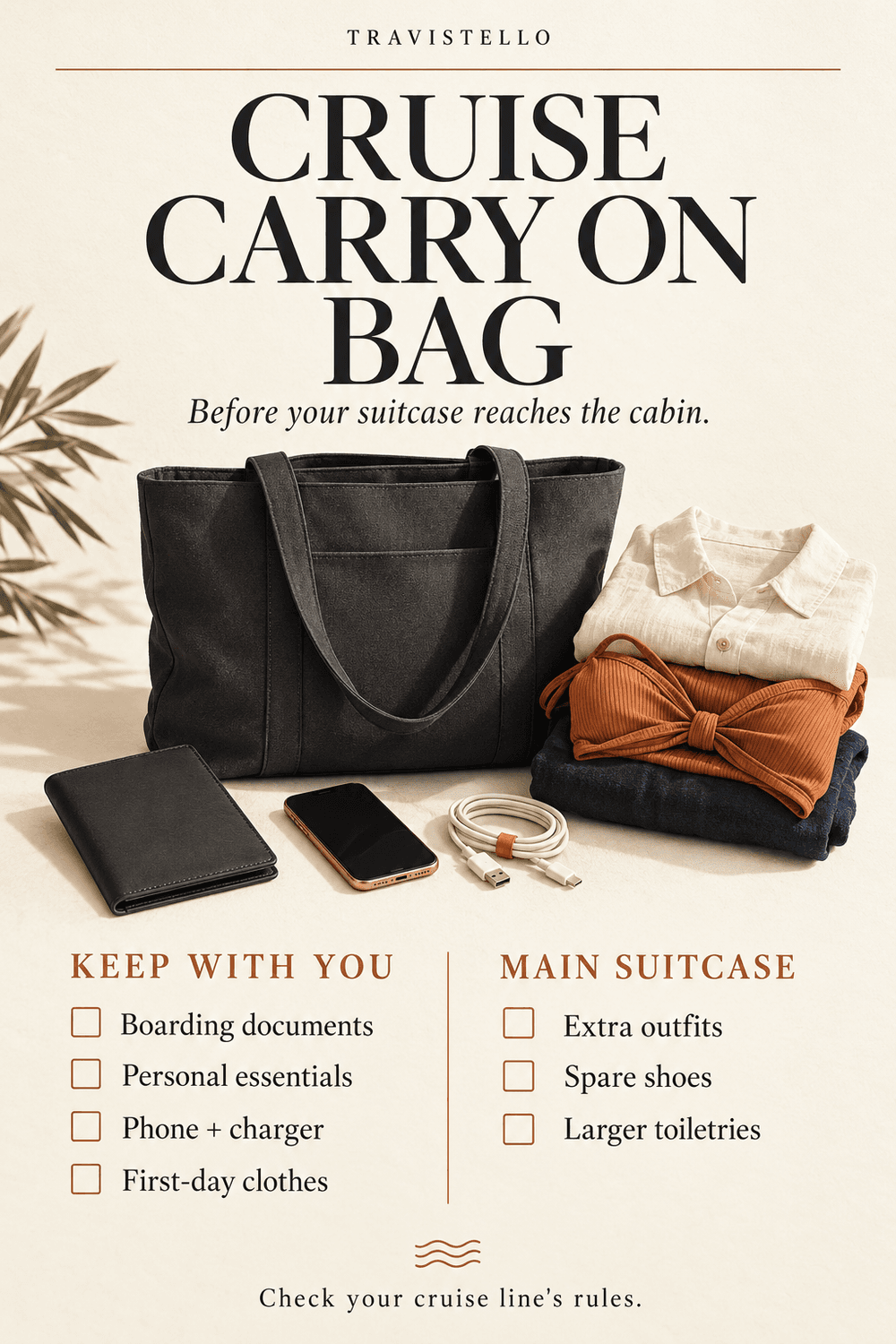
Your cruise carry on bag has one clear job: keep the things you need before your main suitcase reaches the cabin close at hand. Start with that short window rather than the entire vacation. Think through leaving the hotel, reaching the terminal, showing documents, boarding and finding somewhere to sit. Then add the things your first onboard plans actually require. A full week of outfits belongs in the main packing plan; this smaller bag should be easy to close, carry and open while standing. You can use a bag you already own. Lay the proposed contents beside it before considering a purchase, and remove anything that would be equally useful several hours later.
The keep-with-you checklist
- 01
Boarding documents
Keep the identification, boarding details and other documents required for your actual sailing accessible. Check your cruise line's current requirements for every guest; an itinerary or phone screenshot does not replace a required original document.
- 02
Personal essentials and valuables
Place essential medication and the personal supplies you need during the first hours in the bag you retain. Royal Caribbean recommends personally carrying medication in original labeled prescription containers. Follow your own supply instructions and your line's requirements.
- 03
Phone and the charging connection you use
Charge your phone before leaving, and keep the matching cable reachable. Store an offline copy of practical booking details where appropriate. Check ship and airline rules separately for any battery or electrical accessory you plan to bring.
- 04
One change for your first plan
If you intend to use the pool, include a swimsuit and suitable change. If you plan to sit outside or explore the ship, make room for the layer you expect to remove or put on. Choose for the departure weather rather than an imagined beach day.
Separate the jobs
Keep later-use extras in the main suitcase
Put spare shoes, most extra outfits and toiletries you will use after settling in into the main suitcase, subject to your line's rules. Keep a small first-use personal-care set with you only when it solves a specific need. Try the time test for every optional item: would I need this before I can unpack? If the answer is unlikely, it probably does not belong in the day bag. Do not treat this split as permission to check valuables or essential supplies. Pack those according to their own requirements. If you are flying to the departure port, the airport liquids and battery rules remain a separate part of the journey. The linked toiletry and airport guides help organize that earlier stage.
Choose the carry format
A light tote suits a deliberately small first-day kit
A zip-top tote makes sense when the load is modest and you want straightforward access at check-in or a table. Eagle Creek's Packable Tote Bag in Black is one researched example: its manufacturer publishes 26 liters, a 113 g empty weight and unpacked dimensions of 41 by 35 by 20 cm. The adjustable shoulder strap, front pocket and key clip provide simple carrying and access options. The flexible main space still benefits from a separate document wallet and a small clothes pouch. Its capacity is not a target to fill. Choose this format for a manageable load, and test the packed bag on a short walk before departure. The linked research page records its official US offer, material details and warranty exclusions.
Plan for the transfers
A backpack suits a kit you will carry for longer
Choose two-shoulder carry when your route involves several transfers or you want the same bag for appropriate shore outings. The Matador 18L Packable Backpack in Black has a published 18-liter capacity, 255 g empty weight and 46 by 25 by 19 cm dimensions. Its documented features include padded shoulder straps, a removable sternum strap, two bottle pockets and two exterior zipped pockets. Those features give a more organized carry layout, with more empty weight than the tote. Check how your own load sits rather than assuming padding guarantees comfort. Matador describes the bag as weatherproof, while its FAQ excludes submersion. Use suitable separate protection for vulnerable electronics; a water-resistant carry system is not permission to expose documents to spray.
Make the bag easy to use
Give each item a repeatable place
Put documents in a position you can reach without opening the clothing bundle. Keep the phone and cable together, and place personal supplies where you can retrieve them discreetly. Use small pouches you already own if the bag has one large compartment. Close all openings after each check, and leave enough space to put a removed jacket back inside. Avoid dangling several loose bags from the handle of your suitcase when one closed day bag can do the job. If traveling together, decide who carries each shared item before leaving. Every traveler should know where their own immediate essentials are, rather than relying on an unspoken assumption that someone else packed them.


The check before handing over your suitcase
- 01
Read the current instructions
Confirm check-in, required documents, bag screening and prohibited-item guidance for your sailing. Do not use a social-media checklist as the authority for beverages, electrical items or terminal procedures.
- 02
Open the day bag once
Locate documents, personal essentials, phone, cable and your first-day change without unpacking everything. Move any immediate-use item out of the suitcase before the handover.
- 03
Close and carry it
Close the zipper normally and carry the loaded bag around your room or home. Reduce optional contents if the strap arrangement, bulk or access does not suit you.
After your suitcase arrives
Reset the day bag for the next outing
Once you can unpack, remove the first-day change and return belongings to their normal cabin positions. Rebuild the bag for the specific next outing rather than carrying the boarding kit for the whole cruise. A short town visit, beach excursion and active guided trip have different needs. Review your booked excursion's instructions, local conditions and the ship's return guidance before packing that version. Keep the practical organization that worked, but remove duplicates and items you no longer need to carry. The city carry-style guide can help with the tote-versus-backpack decision, and the creator-gear category offers related bag research. A good first-day system should make the rest of the trip easier without becoming another permanently overfilled bag.
Sources and method
Use the line's instructions alongside this checklist
Royal Caribbean's current onboard luggage FAQ supplied the advice on documentation, medication, a first-day change and variable port screening limits. Carnival's currently published 2018 embarkation article supports the general small-bag and accessible-essentials approach; its older check-in timings are not used here. Both were checked on October 5, 2026. Packing order, the time test and bag-choice framework are Travistello editorial recommendations. The lead and checklist are original conceptual artwork; named bag photographs are official manufacturer images. Exact variant specifications, regional prices, source differences and warranty terms appear in the linked product research. Official planning sources: https://www.royalcaribbean.com/faq/questions/onboard-luggage-policy and https://www.carnival.com/awaywego/cruising-fun/what-to-expect/what-you-should-and-shouldnt-do-on-embarkation-day . Recheck your sailing instructions before departure.


