In this guide
Make the day manageable
Plan one area and one indoor anchor at a time
A useful NYC winter itinerary leaves room to shorten a walk, spend longer inside and change the route when the weather turns. These two suggested Manhattan days pair a short outdoor section with one museum, rather than treating every famous stop as a requirement. Use them as separate days or choose the one that matches your interests. Begin with the attraction you actually want to visit, check its opening calendar, and place food and a return route nearby. Keep the outdoor part optional until the forecast and conditions are clear. Our New York fall packing list at New York Fall Packing List: A Practical Carry-On Checklist covers a different clothing decision; this guide focuses on organizing the day once you are there. Museum admission, meals and transport still need their own budget.
The winter day-plan checklist
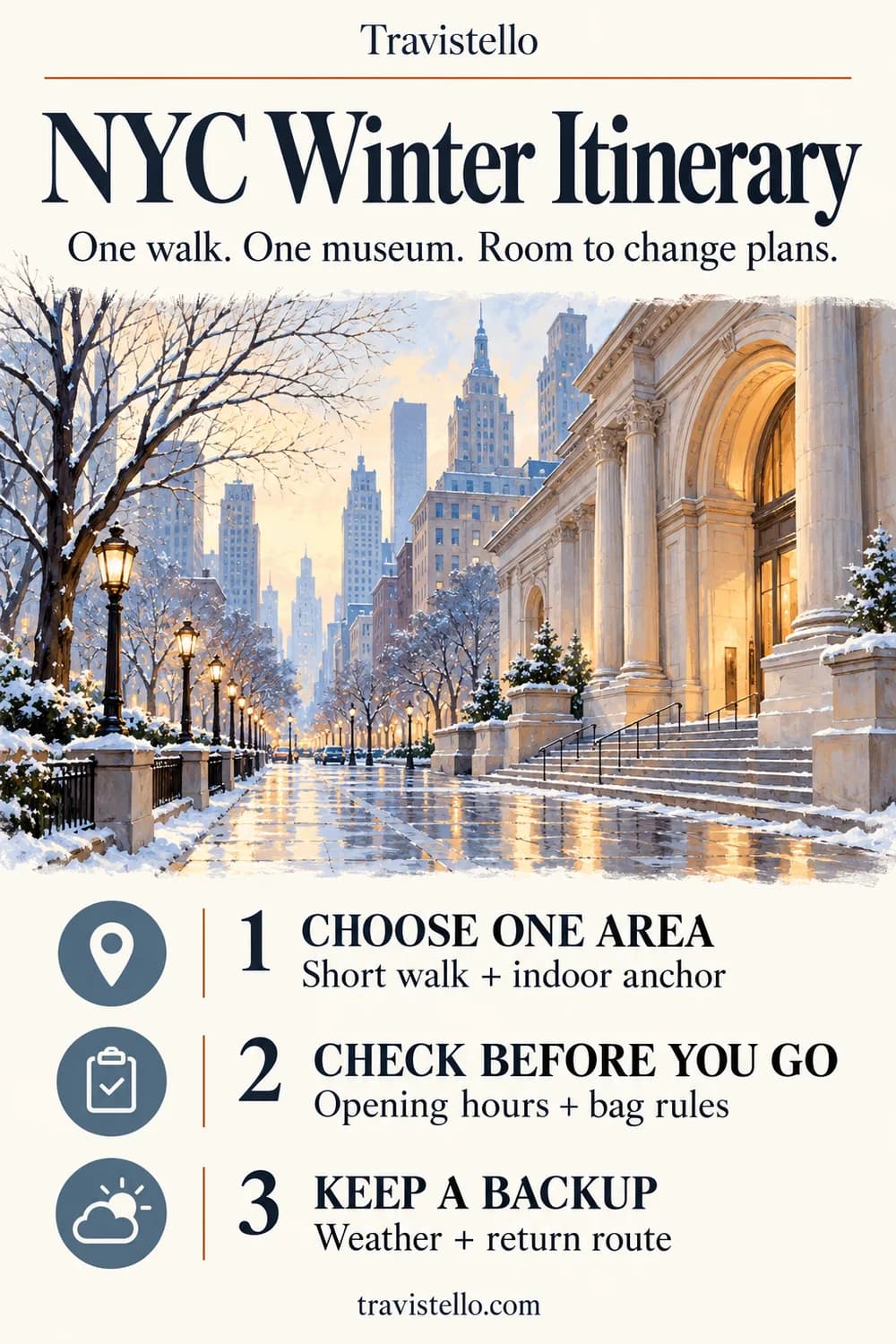
- 01
Choose one area
Pair a short walk with one indoor anchor. Leave room for food, security lines and the journey back.
- 02
Check before leaving
Opening days, ticket availability, current bag rules, forecast and transport notices.
- 03
Keep a backup
Know how to skip the outdoor part, where you will eat and how you will return without a long detour.
Suggested day one
Midtown: a Fifth Avenue walk and MoMA
Use Midtown as a contained day rather than linking it to several distant neighborhoods. If the conditions suit you, make a modest Fifth Avenue street walk the flexible part, with Bryant Park as an optional extension before or after the museum. Choose its length around your starting point and energy. Put MoMA in the main indoor slot and leave a food break nearby rather than booking a second major attraction immediately afterward. MoMA's Manhattan entrance is at 11 West 53 Street; MoMA PS 1 is a different location in Queens. The official visitor page at moma.org has current opening and ticket details. Select the galleries you care about and leave time to enter, store permitted belongings and leave comfortably. This is a suggested pairing, not a timed walking tour or a claim that every seasonal event is operating.

Suggested day two
Upper East Side: a park-edge walk and The Met
On another day, pair The Met Fifth Avenue with a short walk on the eastern side of Central Park when conditions permit. Keep the route close to your museum approach and avoid making a long park crossing necessary to reach the booking. Start with a few collection areas that interest you, allow a meal break and treat extra walking as a choice afterward. The Met's main building is at 1000 Fifth Avenue; The Met Cloisters is a separate uptown destination. The current plan-your-visit page at metmuseum.org lists Wednesday closure and specific holiday closures, including December 25 and January 1. Check the actual date before assigning this day. If your trip falls on a closed day, swap the order or choose another confirmed indoor activity. A winter photo of the park does not establish safe surfaces or present access.
Change the route when needed
Make the indoor version work before booking
For each day, write down the version that removes the outdoor section completely. That could mean traveling directly to the museum, shortening the museum visit around your interests and returning after a nearby meal. Check opening times for the food stop rather than assuming a cafe will be available whenever you need it. Leave enough flexibility that a delayed arrival does not spoil two paid reservations. Consult current city weather and travel notices before leaving; NYC Emergency Management's winter guidance is at nyc.gov. During hazardous conditions, follow official advice and reconsider unnecessary journeys. These plans do not predict snow, promise clear sidewalks or establish that a particular route is open. If a park section is unsuitable, the street route also needs a fresh conditions check.
MoMA bag check
Check the filled bag before your Midtown day
MoMA's visitor policies prohibit objects larger than 11 x 17 x 5 inches and luggage of any size. Bags are inspected and staff can require items to be checked. The museum has checkrooms, but capacity or operational changes can stop further drop-offs. Its FAQ asks visitors to wear backpacks on the front or carry them at their side. Read the current policies at moma.org and the FAQ at moma.org. A compact bag's catalog dimensions are only a starting reference: measure it with your belongings inside and account for protruding pockets. Leave the main suitcase at a confirmed permitted storage location before this visit. Do not build a departure-day plan around the assumption that the museum will store it. Check the rest of the prohibited-item list as well as the dimensions.

The Met has its own rules
Do a separate check for the Upper East Side day
The Met permits small backpacks worn on the front or carried in the hand. Large bags and luggage are prohibited both in the building and at coat check. Its current guidelines allow water in a secure bottle and require a security check. Use the museum's own list at metmuseum.org before choosing the contents. Do not transfer MoMA's numeric size limit to The Met: the two institutions publish different instructions, and staff retain discretion. Review camera, food and other item restrictions rather than treating a bag's small size as blanket permission. If you need an access arrangement or a particular item, confirm it directly with the museum. That is more useful than buying a bag labeled travel or anti-theft and expecting it to settle the admission question.
Keep the day kit small
Allow for your coat and practice the carry routine
Separate what you need in the street from what you need while looking around indoors. Try the day bag over the actual coat, check how you reach the closure and decide where the scarf, hat and gloves will go when removed. A 1.5 L pouch is a very different decision from space for a spare layer or a bottle. Start with a bag you own, put the actual kit inside and carry it for a short ordinary outing before departure. Our city messenger-versus-backpack guide at Messenger Bag vs Backpack for City Travel: Which Carry Style Works Better? explains the carrying trade-offs. The passport-wallet guide helps separate document access from the larger day kit. Keep charging needs realistic; do not make access to a museum wall outlet part of the plan. Retain the accommodation address and return directions where you can access them.


Optional equipment
Choose a smaller bag only when it solves a real need
Two documented crossbodies provide optional reference points. Pacsafe's GO Micro Crossbody is 1.5 L with a published 0.33 lb empty weight; the GO Festival Crossbody is 4.5 L and 0.47 lb. Selected Jet Black US offers were USD 54.95 and USD 69.95 when checked on October 21, 2026 in Warsaw. Their product pages retain exact SKU, dimensions, official photos and source links. The additional capacity may be useful, but check the filled load and closure routine rather than assuming it holds your complete winter kit. Anti-theft is the maker's designation, not a theft-proof or museum-approved promise. The five-year bag warranty concerns manufacturing defects and excludes personal-item losses. An existing Fjallraven crossbody is another reference below. The point is to carry a manageable kit through the day, not add a purchase to every itinerary.
Final planning questions
Can you visit MoMA and The Met on the same winter day?
You can consider both only after checking their calendars, tickets and your transfer, but this suggested plan gives each its own day. That leaves room to see work you enjoy instead of rushing between entrances. If art museums are a minor interest, choose one and leave the other day for a different indoor activity you have verified. Before leaving each morning, check the opening notice, forecast, filled bag and way back. Avoid attaching a nonrefundable evening plan so closely that a slow journey creates another problem. For an airport arrival or departure, use the separate airport-essentials guide and confirm storage and transfer arrangements first. Finish with a plan you can comfortably shorten. The successful winter day is the one that works with the actual conditions and your interests.